

click here to read some of the 
highlights of our tours
April news

News of the month birdwise on Mull has to be the Nuthatch seen by several people in the Dervaig area including Pam and myself. This is the first ever Nuthatch to be recorded on Mull and only the sixth in Argyll so we were very pleased to be amongst the lucky few to see it. Another rarity which we did not get to see was a Lapland Bunting which was around on Mull for a few days in the middle of April.
Most of the spring migrants have now arrived and we at Discover Mull have seen most of the migrant species we have on Mull with a beautiful male Whinchat seen back on territory just this morning, the last day of April. A male Hen Harrier displaying was one of the highlights of the tours for me this month although a Great Skua giving good views ran it close, Pam saw a different male displaying the following day and was just as excited as I had been the previous day. We have been seeing Linnets a lot this month which pleases me no end as it is my favourite little bird. On recent tours we have seen a few Twites always a nice bird to see and Wheatears are everywhere now a sure sign that spring has truly arrived. We are seeing a few waders migrating north as the moment always nice to see resplendent as they are in their breeding plumage.We heard our first Cuckoo only last week but are seeing them on most tours at the moment a rare treat for guests who have not seen Cuckoo’s for years. Finally on the subject of small birds the wonderful Skylarks singing their little heads off surely one of the most evocative sounds spring brings.
Most of the White-Tailed Eagles have now hatched now although the oldest pair on Mull have had some trauma and it seems certain that they have lost one chick and probably one addled egg but this has not been verified yet. This is the pair disturbed by the photographer shortly after they had laid the first egg and had started incubating, we don’t know if the disturbance contributed to the failure of this pair but it cannot have helped. It goes to show how vigilant we still have to be to insure the White-Tailed Eagles survival in this country. Golden Eagles are now on eggs and due to the very good dry weather we have had on Mull for the last 3 weeks we are hoping for a very good hatch this year and with a rabbit boom on Mull a good breeding season 

Rock Doves: note 2 wing bars and iridescent green and purple on their neck.

New birds in the garden are Rock Doves the first we have had actually feeding in the garden the numbers are growing daily after seeing 2 about a week ago, this morning we counted 25 (they must be on ‘Friends reunited), as I write our Sparrow Hawk has just put in an appearance scattering the little birds in all directions. Most of our Hebridean ewes have now some of our new lambs, 2008
lambed with 7 lambs on 5 ewes, they are all very healthy and now enjoying having ‘lamb races’ around the field.
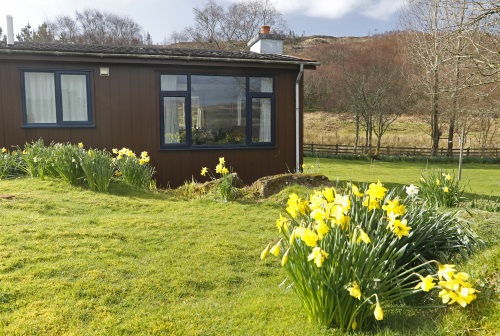
We are seeing Otters on most tours and both Common and Grey Seals daily, Red Deer are everywhere and in some areas (our garden for one) they are becoming a problem having dead headed most of our daffodils while they are still in full bloom. PAM IS NOT AMUSED! Rabbits also in abundance and we are seeing a few Hares and on one tour we had good Bottle-Nose Dolphin sightings a rare treat. Finally I must mention the weather again as it has been really good for three weeks now but according to the weather forecasts it rains all the time in Scotland. This is a wonderful island whatever the weather so don’t be put off by weather forecasters standing in front of Mull telling you it’s raining or going to rain as they often speak with forked tongues.
Enjoy the Spring Arthur and Pam 


Mull is a naturalists' heaven with several ecologies wrapped in one small island, but we wouldn't have seen a quarter of what's on offer without Pam & Arthur's insider knowledge. You get a class act when you hire them for a whole day, along with some comical patter and Pam's homemade veg soup, sarnies, flapjacks and cake.
Sharon Ring, Sainsbury's Magazine March 2007
book early to avoid disappointment.
February/March News

There is little we can tell you about Mull in February as we were away Whale watching in Baja California for most of the month. We had a terrific holiday and Pam achieved 3 lifetime ambitions, seeing really close Blue Whales, we had 7 around the boat at one time including a mother with calf, awesome. We also saw breaching humpback Whales just in front of the boat which was a fantastic sight, but Pam’s highlight was actually stroking a Grey Whale in the San Ignatio Lagoon apparently the only place in the world you can do this, and amazingly they come to you and not vice versa. If you really want to get close to whales check out www.bajawhale.com we can really recommend them but you must be o.k. on boats as you are on one for 12 days. The only slight disappointment for me was the birding, it is much better on Mull.
Great Spotted  Woodpecker
March started with indifferent weather on Mull, talk about in like a lion well we had the lion but it was a very wet one, we were able to get out and about on a couple of days and had some great birding. On the first day of really good weather we went out and about just to see what Mull had to offer in early spring and we were not disappointed as we saw 56 bird species and 4 mammals in the short day. The highlight had to be the Golden Eagle that flew over our new vehicle and landed on a rock no more than 100 yards away, it proceeded to lie flat on the rock and spread its wings out along the warm rock face, enjoying the sun after a cold wet spell. We had never seen this behaviour before and it was incredible to see all the wing feathers spread out showing all the subtle hues of gold and brown which you rarely get to see on a flying bird. In all we saw 5 different golden Eagles in the day and also Three White-Tailed Eagles, the first one flying over our house just before we started out. The second White-Tailed eagle was carrying nesting material and we have already got one pair sitting on eggs and a man has been arrested for disturbing them at their nest, good to know that the Mull Eagle watch is still very vigilant. 

male Hen HarrierWe had a Hen Harrier hunting always worth seeing, 2 Sparrowhawks, Buzzards galore and a Kestrel, a total of 6 species of raptor in the day. Birds of the day for me after the Golden Eagle was a pair of crossbill, quite a few have been seen on the island recently but these were the first ones I have seen for a couple of years.
We have seen otters every time we have been out this month but the best view was of a mother with 2 cubs no more than 20 yards from where we were standing. I do not think she could have seen or smelt us as she brought her youngsters down the hill, through a drain under the road and right past us to the shore, wonderful, it is always good to know where otters with cubs are. 


Fallow Deer seamed to have done very well last year as we saw several young fawns with their mothers recently. We have at least one very white fallow deer and some that are nearly black this is not unusual for Fallow deer as they come in 4 distinct colourations.
Red deer are everywhere and we get some in our woodland and paddock every morning. Our garden is full of birds at the moment and it is a great time of year to see them as they are all coming into their beautiful breeding plumage. Pam saw 3 Bullfinches and 7 Long-tail Tits the other day and we have at least 15 species in the garden. The female Greater Spotted Woodpecker has been back on our feeders this week and we have heard her drumming in the nearby wood so we are hoping if she has young she will bring them to our feeders. 
Our Hebridean ewes should be starting to lamb soon and we will post pictures on the web site when this happens. Have a great Easter and try to get out and about in the country if you can, it is very rewarding after the long dark nights of winter.
Arthur and Pam


January 2008 news

What is it I wonder that makes Mull such a wildlife paradise? On our annual bird race with the bird club on January 12th 89 bird species were seen with the winning car seeing 73 species, this is a great return for one days birding on a relatively small island. When we met up at the end of the day we were not only surprised at the number of birds seen but also at the several species we had missed. This is born out by our ongoing British Trust for Ornithology (BTO) bird survey which showed Mull had over 100 species seen in November and December 2007. In the Dervaig area alone over 60 species of birds were recorded including Water Rail in the reed beds and on Barn Owl by Jim Bevanour way home from the bird club the other night we saw a Tawny Owl and a Barn Owl just before we turned into our drive. Owls are thriving on Mull and we were woken this morning by a pair of Tawnies calling from a tree in the garden outside our bedroom window. Why is it that Mull has this abundance and diversity of birds? Do we have any reserves on the island to attract so many species? No we don’t although there is an R.S.P.B. presence on the island to monitor the White-tailed Eagle programme we now have at least 10 pairs on Mull and the Corncrakes on Iona. Do we have any other wildlife initiatives on the island not available elsewhere? Again the answer is no. The answer lies in the people in particular the way Mull is farmed, it has never been subject to farming on industrial scale except by forestation and now that is changing for the better and so the wildlife has been able to adjust to subtle changes without being unduly affected. I know that history shows that a few species suffered from the introduction of sheep and the change from mixed farming to a grazing culture most notably the Grouse and Grey Partridge but this has been more than made up by the increase in raptor numbers including Golden Eagles, Peregrine Falcons and the much persecuted Hen Harrier. Even as I write some more small changes are taking place on the island, farmers are removing some sheep off the hills; this in turn could mean a return of some of the heather to the hills and encourage the return of Grouse. On one estate a new 2000 acre traditional Birch and Oak woodland has been planted and if this is successful it will provide even more diverse habitat and encourage even more species to this remarkable wildlife paradise.
Barn Owl by Jim BevanIt is not only birds that benefit from a sympathetic and rural community; mammals are also thriving here in particular Red Deer numbers are at near the optimum numbers that the island can sustain. Otters too are here in very good numbers making Mull one of the best places in Britain to see this special mammal. Both Grey and the smaller Common seal are to be found all round the coast if you know where and how to look for them. Minke Whales, several species of Dolphins, Basking Sharks and porpoise are all seen around Mull’s coast often from land, so even not having sea legs does not necessarily mean you have no chance of seeing these exciting creatures. This and the spectacular geological scenery including the remarkable Fingals Cave on Staffa, wonderful walks on Mull, Iona and Ulva make Mull the outdoor wildlife paradise that it is.
This island is a perfect place to recharge your batteries from the pace of modern living, the beautiful shell sand beaches almost deserted in the early mornings, surely the best part of the day. The moorland and mountains with their own particular habitats, flora, fauna and charm where you can walk and become as one with the nature that is all around you. The castles, bridges, drove roads that remind us of a much harder life in the not to distant past are all here to be discovered.


Dec 2007 News
Tours between end of October and March are few and far between but this gives us time to get involved in other birding projects. This winter we have put up boxes for Barn Owls, Tawny Owls, Kestrels, Treecreepers, House Sparrows, Tits and of course Robins around the farm in the hope that this will help more birds to breed successfully each year. The farms 10 year old wood now hosts Woodcock and Pheasants despite the Red Deer doing their best to handicap its progress. The bird feeders continue to be regularly emptied by our numerous garden birds and the Greater Spotted Woodpecker mentioned in the last news letter has now become a regular visitor. I believe it is important for people like us who earn a living out of wildlife to actively help wherever and whenever they can and not just promote wildlife, leaving it up to others to put in the time and effort for us to benefit from.   Ardrioch Garden Birds
 Pam and I are now actively involved with the 2007-2011 British Trust for Ornitholgy (B.T.O.) bird atlas, this involves going out into areas and counting all the birds you see and adding them to a computer list of birds all over the U.K. As you can tell this is no hardship for me, just another excuse to go birding but with some scientific purpose behind it. The other obvious benefit is that it gets you out in the open air exercising without realising it, much better than the gym. A recent walk took me up my favourite mountain on Mull, Beinn Talaidh, and the views as well as the birds were spectacular. We also add any birds that we see when we are out travelling; this is known as Roving Records and can be done by anybody at anytime with little inconvenience. If you want to get involved in this very worthwhile project go to www.birdatlas.net
During the first 2 months of this project over 70 species have been seen on Mull and a total of over 75 Crossbills many of them in breeding pairs, good news indeed. As well as the usual Eagles and Otters we see on most days we had a great Merlin sighting and good views of an Iceland Gull when out recently on a bird club field trip.
In May next year, in Wild Isles Week we are taking part in a bird club spring bird race, If anyone may be interested in joining us for this event it would be advisable to book early to avoid disappointment. This should be a fun event seeing how many species of birds we can see in a given time on one particular day.  I will provide more information on this event next month, but in the meantime may we wish all guests and readers of this page a very happy new year.
Arthur & Pam

Nov 2007 news

A major change at ‘Discover Mull’ tours for next year; we have replaced the Landrover with a Ford Torneo Mini-bus for the tours. We are sorry to see the end of the Landrover but due to new transport and seat belt laws it means that we would have had to loose 2 passengers from our carrying capacity. The old Landrover, as some of you may know, had started to let us down badly and in fact needed a new engine in the summer, so a decision was made and it had to go. On the plus side the Mini-bus has much more room inside and is easier to get in and out of, it also has all forward facing seats and larger windows. The rear door is very large and when raised can act as a very large umbrella so guests can still be out-side in the rain with out getting too wet, so we look forward to next season with optimism for another fantastic year. 

On the bird front our garden is full of birds, at least 200 at any one time on the feeders and ground, it is costing us a fortune, but they are so delightful to see. Check out our new garden bird pictures page, (insert link here) all the photographs are either taken by Arthur or guests staying in our self-catering. There are up to 15 species a day in the garden with high-lights being Yellowhammers daily, Bullfinches and Sparrowhawk, we also have Buzzards everyday and a Hen Harrier often fly’s over our fields and woods. Our main priority on Ardrioch at the moment is Owls with Tawny and Barn Owls competing for territory on the farm. We have just put up a new Barn Owl box on the big shed to encourage breeding on the farm as we have plenty of prey in the shape of Field Voles in our still establishing woodland. Our other main wildlife stars at Ardrioch are the Red Deer, they do not help with my tree planting or Pam’s gardening but guests love to see them, let’s not forget the sheep and rabbits in the front field. As I am writing this news letter a Great Spotted Woodpecker has landed on our peanut feeder this is the first time I have seen a Woodpecker in our garden ………hurray.

The wildlife this year has been fantastic; we only missed seeing Otters on 7 tours, I am sorry if you were on one of them. Golden Eagles and White-tail Eagles have been showing well this year and Mull is rightly called ‘Eagle Island’. With over 100 species of birds to be seen in a week on Mull along with Seals, Whales, Dolphin and Porpoise around the coast it is no wonder that Mull is Britain’s premier island to visit to see wildlife and we are lucky enough to live here. Check out the wildlife highlights to be seen on Mull at the bottom of this page. At present we have an Iceland Gull and a Black-tailed Godwit on Mull and also 6 species of Geese have been seen this month. All this and of course the spectacular scenery of which Mull is renowned, white sandy beaches, mountains, moorland and lochs make the island a fantastic place to live and visit.

I cannot finish this news letter with out thanking all our guests for travelling with ‘Discover Mull’ this year or staying in Ardrioch’s self-catering cottages. We would like to take this opportunity to wish you all a happy Christmas and a wonderful peaceful New Year and hope to see some of you on Mull in the near future. Grateful thanks once again to our good friend Alan Spellman for continuing to maintain our web site, check out all Mull’s rarer sightings on his mullbirds web site. 

Best wishes Arthur & Pam 
September news
   A month of comings and goings, most of our summer visitors leave either before or during September, however a large number of Swallows are still here both delighting and surprising guests at the end of the month. A few late Wheatears are still being seen and Gannets and Guillemots on most tours but not in great numbers. Arctic Terns were giving us great sightings flying really close and diving for small fish like Sand eels in preparation for their long flight to the southern oceans. Winter birds arriving include a single Black-Tailed Godwit, Widgeon and a
Pale Bellied Brent Goose seen by Pam and guests recently when I was at the dentist, a double whammy on the same day. Golden Eagles still giving great views, see picture taken by a guest whilst on a tour. White-Tailed Eagle every day with some spectacular sightings like a juvenile swooping and taking a rabbit, where was I? In the dentist chair that’s where. We are seeing more Hen Harrier lately as they leave their breeding grounds and move to more communal roosts, some will partially migrate further south for the winter. All three Divers are being seen and some Slavonian Grebes have returned for the winter as the days get shorter.
   We have seen porpoise more often recently as the calm winds mean the Lochs are like glass, Otters sighting has also been easy and I can truthfully say we saw otters on every tour in September and we were out on most days. The Deer rut is now well under way and  roaring stags can be heard in most parts of this wonderful Island. It is a great pleasure to show guests Britain’s largest land mammal in their pomp as they are at this time of year.
   A note of commiseration to the sheep farmers on Mull who have worked all year and because of the foot and mouth outbreak cannot take their lambs to market, although it is heartbreaking for those who lose stock it can mean financial ruin for the ones who cannot get stock to market and also get no compensation. Visitors to this magical island will realise that it is down to the farmers who look after the land that we have such a fantastic place to visit so let’s hope the present outbreak doesn’t last much longer and life can return to normal.
    Thanks to all the landowners and farmers for all their help again this year, to the police, Dave Sexton the R.S.P.B. officer on Mull and the people of Mull for all their time in ensuring the wildlife on Mull is left undisturbed for us all to enjoy. Finally to Alan Spellman thanks again for looking after our Web-Site, for more information about mull and its birds visit www.mullbirds.com

August news letter 2007
 August is a month when we start to see lots of new young animals and birds appearing as they grow more confident after being born or fledging. The new Common Seal pups are delighting guests as they playfully leap out of the water as if they were Dolphins, this is called porpoising and it does indeed confuse guests and other Mull visitors alike as they have never witnessed this seal behaviour before. The Otter cubs we are seeing on most days are also giving our guests great value playing and squabbling together nearly all the time even when fishing. The other day after a long successful fishing session the 2 cubs along with their mother climbed out onto the top of a large island and after a brief bout of preening settled down for a sleep, this lasted less than 3 minutes before the cubs started fighting and they tumbled right from the top of the island down the slope and into the water where a game of catch me if you can began much to the amusement of all my guests. These wildlife events are precious and must not be lost because we humans keep demanding more of their habitats for our space. The other special mammals we are seeing regularly now are the new Red Deer calves and Brown Hares as the farmers have now harvested the grass we can again see these beautiful creatures as they come out to graze in the late afternoon.
Most of the summer flowers are now over being replaced by some glorious heather both Bell Heather and Ling being very abundant this year. The Grass of Parnassus a particular favourite of ours is also in flower and we had some late Orchids well into August this year. Two other flowers of August worth a mention this year are the Rose Bay Willow Herb and the Purple Loosetrife which have added some beautiful colour to the late summer. On a more cautious note the occurrence of Ragwort on the island is increasing and we feel something should be done about this poisonous to livestock, particularly horses before it becomes too well established.
As for the birds both Golden Eagle and White-Tailed Eagle chicks have now fledged and can be seen if you know where to look. The proud parents are never too far away and as I write Pam just phoned to say she and our guests were watch 5 White-Tailed Eagles in the air together, curses I only stayed at home to write this news letter. As well as the Eagles we have been seeing Peregrines with young Kestrels and a special sighting of a Goshawk. In the sea lochs Gannets, Kittiwakes, Black Guillemots, Guillemots, Arctic and Common Terns, Cormorants and Shags as well as moulting Eider Ducks and Red Breasted Mergansers and August is a quiet month.
Finally I must mention Pam whose home baking for the tours is becoming so legendary I have started to think some guests only come out with us for the food. Their was I thinking it was Mulls fantastic wildlife, scenery, flowers and of course my wit and repartee? How wrong can you be!
  Enjoy wildlife watching, get involved the B.T.O. is doing a new Atlas and needs volunteers if nothing else it gets you out and about. Cheers Arthur and Pam


The Isle of Mull bird club web site
is now up and running,
it has details of the programme of meetings
and activities for the coming months.

The club is open to all


'A top 20 list of what can be seen on a 'Discover Mull' tour'

 1 Golden Eagle Mull has the largest population of this ‘master of the skies’ in Europe.
 2 White Tailed Eagle Just the size of this endangered species has to be seen.
 3 Peregrine Falcon This beautiful bird is just an amazing flying machine.
 4 Eurasian Otter One of Mulls special sights, to see them is to love them.
 5 Bottlenose Dolphins The playful mammal of the sea, often seen from land.
 6 Minke Whale They may not be the biggest, but we have lots.
 7 Grey and Common Seals     When they do move they will watch you.
 8 Red Deer Britain’s largest mammals, ‘Monarch of the Glens’
 9 Hen harrier Graceful flyers, Britain’s most persecuted bird of prey.
10 Gannets Plunge diving one of wildlife’s most exciting spectaculars.
11 Basking shark The second largest fish in the world, but feed on tiny planktons.
12 Short-eared Owls Special sight to see this daytime hunting owl
13 Harbor Porpoise Endangered, but nice to see if you can spot them.
14 Puffins Guillemots and Razorbills     Breeding bird colonies fantastic noisy places
15 Orchids and other colourful wildflowers     Beautiful to see and photograph
16 Birds of Prey Buzzards, Kestrels Sparrowhawks and the rare Merlin and Osprey.
17 Fallow Deer Delicate deer of the woodlands, our favorite.
18 Red throated Divers all year, Black throated & Great Northern autumn, winter & spring
19 Brown Hares and Mountain Hares     Fascinating creatures and boy can they run!
20 Butterflies, Moths and Dragonflies    So perfect, some so rare

page backnext page